- News
- Visit
- Column 2
- Opening hours outside of Hessian school holidaysMon-Fri 9.30am - 2pm, Sat,Sun 10.30am - 5.30pmOpening hours during the Hessian school holidaysDaily 10:30am - 5:30pm
- Activities
- Exhibitions
- Group
- EXPERIMINTA
- English
- News
- Visit
- Column 2
- Opening hours outside of Hessian school holidaysMon-Fri 9.30am - 2pm, Sat,Sun 10.30am - 5.30pmOpening hours during the Hessian school holidaysDaily 10:30am - 5:30pm
- Activities
- Exhibitions
- Group
- EXPERIMINTA
- English
- News
- Visit
- Column 2
- Opening hours outside of Hessian school holidaysMon-Fri 9.30am - 2pm, Sat,Sun 10.30am - 5.30pmOpening hours during the Hessian school holidaysDaily 10:30am - 5:30pm
- Activities
- Exhibitions
- Group
- EXPERIMINTA
- English
Pop-Up Auststellung
From exciting installations and interactive experiments
Whether it’s a sorting game on the topic of plastic and sustainability, homemade table tennis ball machines or a journey through the inventions and discoveries of female scientists, our pop-up exhibitions are as diverse as science itself. A pop-up exhibition can last anywhere from one week to two months, but one thing is certain: it disappears as quickly as it appeared.
This special form of temporary exhibition gives both large and small projects the opportunity to share their results with our visitors. Always new, always flexible and never boring. Be part of this unique exhibition format and discover the diversity of our pop-up exhibitions.
Current Pop-Up Exhibition
Tinkered
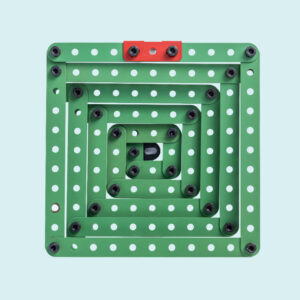
Machines out of the metal construction kit
What has captivated people for generations about metal construction sets? Why do gears, screws, levers, and moving mechanisms still hold such a fascination today?
The pop-up exhibition “Tinkered: Machines out of the metal construction kit” is dedicated to a toy that brings together the history of technology, creativity, and personal memories.
The focus is on the impressive machines created by master mason Rudolf Müller (1949–2024), which he developed after his retirement using modular metal construction parts. His movable structures demonstrate not only his craftsmanship but also his joy in tinkering, experimenting, and inventing.
The exhibits offer new perspectives on the significance that playful construction can have for people of all ages.
Modular design, standardization, mechanics, and technical understanding can be experienced here in a playful way.
“Tinkered” invites visitors to rediscover the metal construction set as a cultural asset and as a bridge between play, technology, and art.
When?
June 30, 2026, through August 10, 2026
Where?
EXPERIMINTA ScienceCenter
The pop-up exhibition is included in the regular admission price.
Past pop-up exhibitions
Everyone is talking about transformation, but what exactly is it, and why is it important? At the STEM centers at Leibniz School in Frankfurt Höchst, Josephine Baker School in Riedberg, Bertha von Suttner School in Nidderau, and Heinrich von Kleist School in Eschborn, students spent half a semester exploring this question. In a total of two workshops, they explored climate change, climate impacts, and renewable energy. They tested hydrogen-powered model cars, investigated whether the flow rate of the Nidder River is sufficient to generate electricity, learned all about solar energy, and built a wind turbine.
The centerpiece of the exhibition was a diorama that illustrated the importance of various renewable energy sources. The diorama was complemented by experiments related to renewable energy.
The Power Up project is a partner of the “Energiewende-Held:innen” (Energy Transition Heroes) initiative of ANU Hessen e.V. It is sponsored by LandesEnergieAgentur Hessen GmbH with funding from the Hessian Ministry of Economics, Energy, Transportation, Housing, and Rural Affairs. Additionally, Power Up’s work in the STEM centers is financially supported by the “Stuart & Friends” initiative.
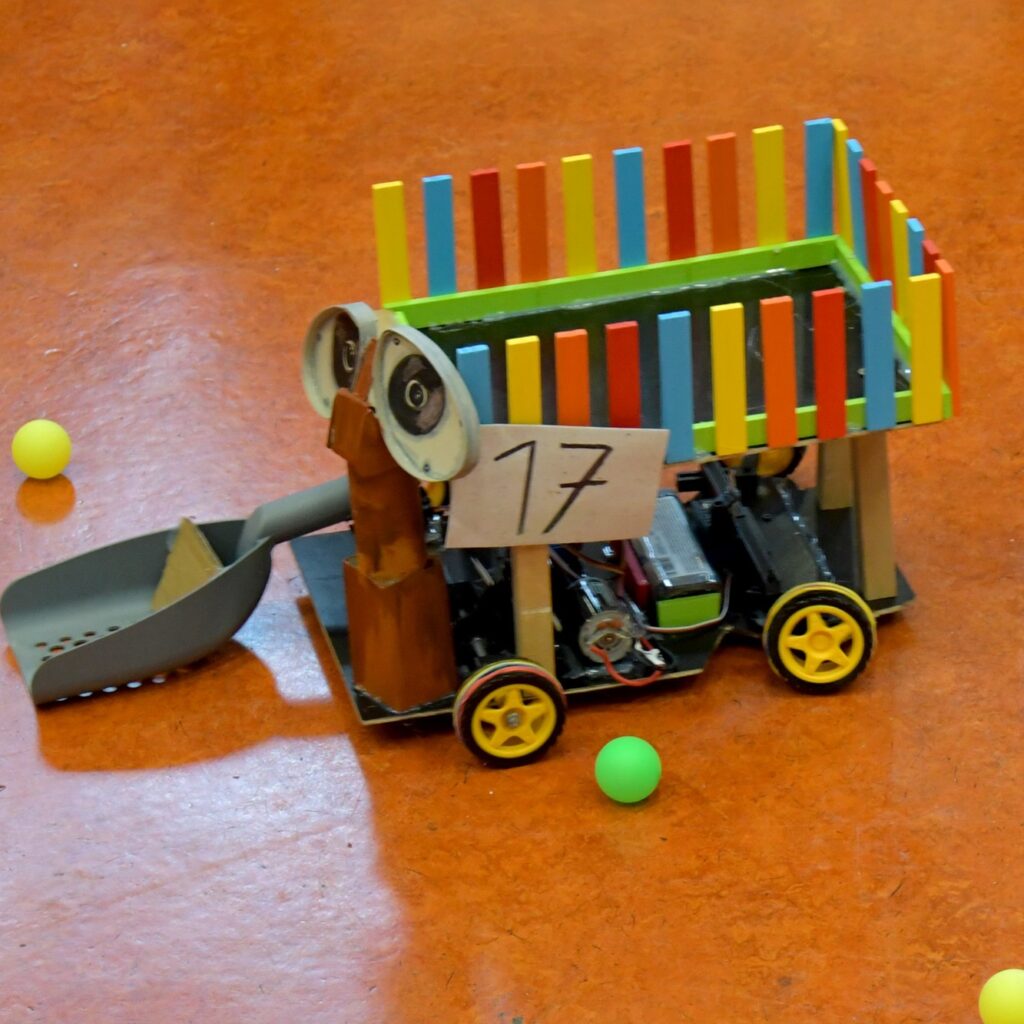
From January 22 to February 15, 2026, the pop-up exhibition “Ball Kid Master 2025” took place at the EXPERIMINTA ScienceCenter in Frankfurt.
The exhibition showcased selected results from a startup project at Frankfurt University of Applied Sciences (Frankfurt UAS). As part of this project, first-year students in the mechanical engineering bachelor’s programs demonstrated their technical skills, creativity, and teamwork abilities right at the start of their studies.
The students developed kits for remote-controlled ball-collecting vehicles designed specifically for children aged 8 to 12.
A special focus was placed on sustainability and upcycling. In addition to specified technical components, the students worked with a limited budget and specifically used materials that would otherwise not have been reused.
The exhibition was complemented by a hands-on event where visitors could control and test drive selected ball-collecting vehicles themselves.
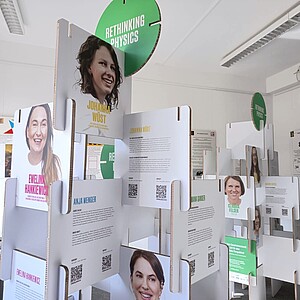
To mark the United Nations International Year of Quantum Science and Technology, the ct.qmat – Complexity and Topology in Quantum Matter Cluster of Excellence at the Universities of Würzburg and Dresden presented the travelling exhibition RETHINKING PHYSICS.
It featured portraits of established and emerging female researchers who talked about their enthusiasm and fascination for scientific work, their successes and their goals.
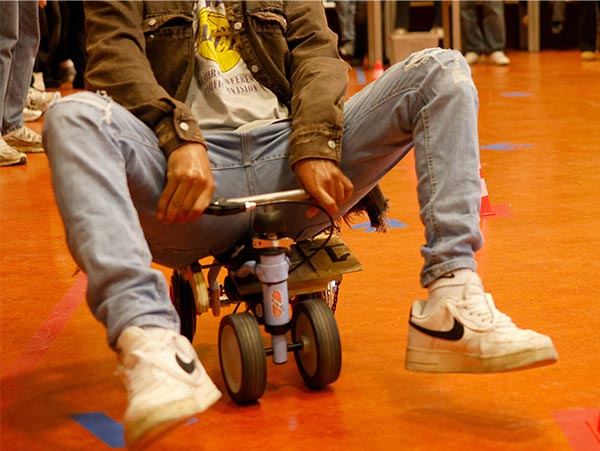
The ‘Mini Akku Racing’ project by first-year mechanical engineering students at Frankfurt University of Applied Sciences combines the art of engineering, the spirit of discovery and a lot of fun.
The challenge was to design and build a kit for a vehicle powered solely by a standard cordless screwdriver. The results can be seen here from 6 January to 3 February 2025. Experience innovative technology up close and discover how simple materials can be turned into impressive racing vehicles. Each vehicle is designed for easy assembly and disassembly – perfect for young inventors!
Special highlight: Hands-on activity on 18 January
On 18 January, you can try out the vehicles for yourself! Students from the Frankfurt University of Applied Sciences will be on hand to present their creations and give an exciting insight into how they are built and how they work. Fun for all the family!
When: 6 January – 3 February 2025
Where: Experiminta Science Centre
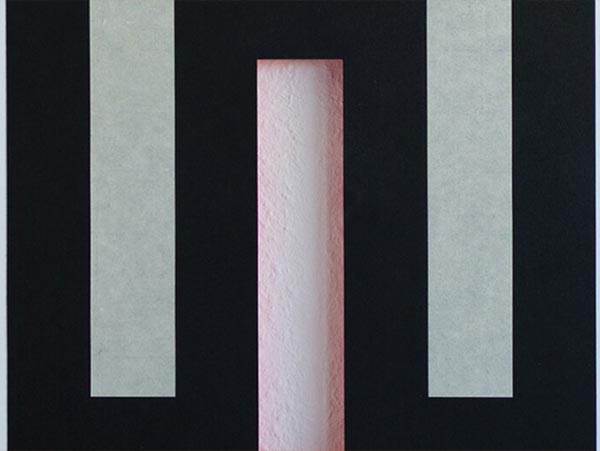
From 20 April to 2 June 2024, the artist Alwin Dorok asked himself the fundamental question of what makes a picture a picture, or what painting is. He came to the conclusion that any kind of painting, regardless of content or style, can be reduced to three elements: Form, colour and style.
In the pop-up exhibition, Alwin Dorok showed more recent works that primarily deal with the metrics and rhythm of stripes in interplay with the basic form, the square, or squares among each other.
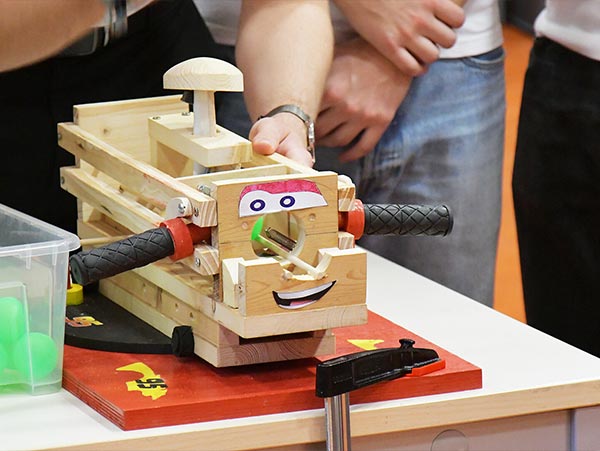
What exactly is a table tennis ball machine and how do you build one? This was the question asked by mechanical engineering students from the Frankfurt University of Applied Sciences, and pupils from the Elisabethenschule Frankfurt, an Experiminta cooperation school.
They tinkered and built things out of recycled materials. And they came up with some amazing results. Mechanical engineering at first hand.
From Tuesday 27.02.2024 to Thursday 11.04.2024 we will be showing the results in our pop-up exhibition Ing Pong.
And if you want to try out the table tennis ball machines for yourself, you can join us live on Saturday 6 April 2024 from 10:30 to 17:30 at the Action Day. Let the students explain the ball machines to you and shoot a few table tennis balls yourself.
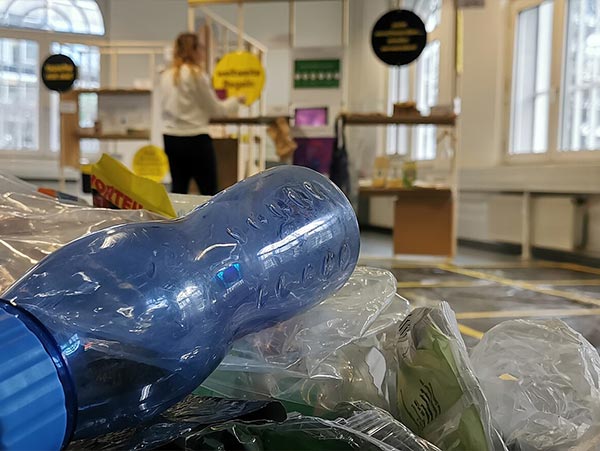
Our first pop-up exhibition is waiting to be discovered. From Monday 11.12.2023 to Friday 15.12.2023 the results of the project “Think plastic-free, act sustainably” of the Gymnasium Süd in Frankfurt a. Main – in cooperation with the Umwelt-Exploratorium – can be explored in our ScienceCenter EXPERIMINTA.
Plastics are part of our everyday lives, which is why it is becoming increasingly important to raise awareness of sustainable consumption. This project, created as part of the European Week for Waste Reduction, aims to do just that.
A shelf of packaging alternatives showcases the students’ creative solutions. This is complemented by exciting exhibits from the Fraunhofer Institute for Structural Durability and System Reliability LBF in Darmstadt. These show what is exciting and new in plastics research and development.
But the key question is: how can we put all this into practice? Join us and students from Frankfurt’s Gymnasium Süd to discover what it means to consume sustainably. Explore the pros and cons of plastics and discover the results of this innovative project in our pop-up exhibition “Think plastic-free, act sustainably”.

Opening hours
Please note our current information.
Contact
Tel. 069 / 713 79 69-0
We are reachable from Monday to Friday between 10:00 a.m. and 12:00 a.m.
Fax 069 / 713 79 69-190
info@experiminta.de